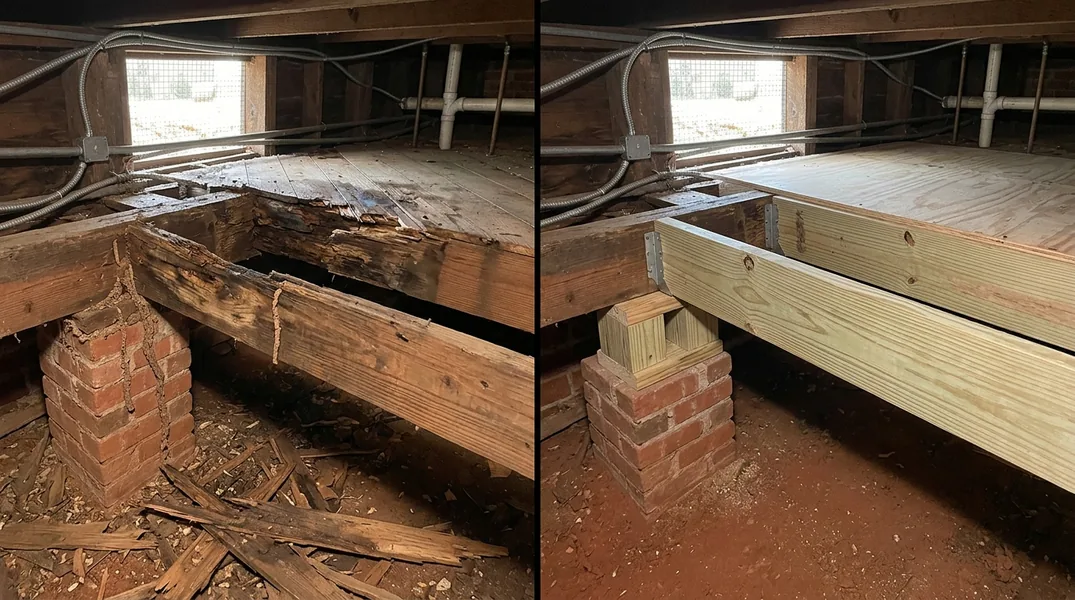
Why Winston-Salem's Crawlspaces Are Vulnerable to Wood Rot
If you own a home in Winston-Salem, you're likely familiar with the region's distinctive red clay soil. While beautiful and characteristic of the Piedmont, this clay presents a unique challenge for homeowners: it doesn't drain water the way sandy or loamy soils do. Instead, it holds moisture like a sponge, creating persistently damp conditions directly beneath your home.
Your crawlspace sits at ground level, separated from the soil by only a thin vapor barrier (if you're lucky). When heavy rains fall or groundwater rises, that moisture migrates upward through the soil and into your crawlspace. The red clay surrounding your foundation acts as a moisture trap, preventing evaporation and keeping humidity levels dangerously high. In crawlspaces without proper ventilation or dehumidification, relative humidity can exceed 80 to 90 percent year-round. This is the ideal environment for wood rot to flourish.
How Crawlspace Moisture Damages Floor Joists and Subfloors
Your floor joists and subfloor are not designed to live in a swamp. These structural members rely on staying relatively dry to maintain their strength and integrity. When Wood Rot & Dry Rot Repair becomes necessary, it's almost always because moisture has been allowed to persist for months or years without intervention.
Wood rot begins when fungal spores, which are everywhere in nature, find three conditions they need to thrive: wood, oxygen, and moisture. In a damp crawlspace, all three are abundant. The fungus breaks down the cellulose in the wood fibers, causing the material to soften, weaken, and eventually crumble. What makes crawlspace rot particularly insidious is that it often goes unnoticed. Unlike attic rot or exterior rot, you don't walk through your crawlspace every day. By the time a homeowner discovers the problem, significant structural damage may have already occurred.
Rotted floor joists lose their load-bearing capacity. A joist that has lost 25 percent of its cross-sectional area due to rot can no longer safely support the weight of your home, furnishings, and occupants. You may notice soft spots in your floor, uneven surfaces, or even a slight bounce when you walk across certain areas. These are warning signs that Floor Joist & Subfloor Repair is needed urgently.
Recognizing the Signs of Crawl Space Moisture Damage in Your Home
Early detection of crawlspace moisture damage can save thousands of dollars in repairs. The problem is that many homeowners don't know what to look for. Unlike a water stain on a ceiling, which is obvious, crawlspace rot announces itself through subtle changes in how your home feels and functions.
One of the first signs is a musty odor in your basement or first floor. This earthy, damp smell indicates active mold growth, which thrives alongside wood rot. You might also notice that your hardwood floors are cupping or buckling, or that doors and windows are sticking more than they used to. These changes occur because moisture is being absorbed into the wood framing, causing it to swell unevenly. If you have a crawlspace, the most direct way to confirm a problem is to inspect it yourself with a flashlight and a moisture meter (available inexpensively at hardware stores). Look for visible soft or discolored wood, white or gray fungal growth, or areas where the wood crumbles easily when prodded.
In Winston-Salem, where crawlspace moisture damage is common, waiting to act is expensive. The longer rot is allowed to progress, the more structural members become compromised. What might have required replacing a single beam can escalate into a project requiring Beam Replacement & Load-Bearing Wall Removal if the damage spreads to primary support structures.
Moisture Control Solutions to Stop Crawl Space Rot Before It Starts
Prevention is always cheaper than repair. If your crawlspace is currently damp but you haven't yet discovered rot, now is the time to act. The foundation of any moisture control strategy is to prevent water from entering the crawlspace in the first place and to remove moisture that does get in.
Start with drainage. If water is pooling around your foundation or if your gutters and downspouts are directing water toward your home, fix that immediately. Downspouts should extend at least 4 to 6 feet away from your foundation. Grade the soil around your home so that it slopes away, encouraging water to drain naturally. Inside the crawlspace, a properly installed vapor barrier (6-mil polyethylene sheeting) over the soil can reduce moisture infiltration by up to 50 percent. However, the barrier must be continuous, sealed at seams and edges, and extended up the foundation walls to be effective.
For crawlspaces with persistent moisture problems despite these measures, mechanical dehumidification is often necessary. A crawlspace dehumidifier can maintain humidity levels below 55 percent, which is the threshold above which wood rot fungi thrive. Some homeowners also benefit from crawlspace encapsulation, a more comprehensive approach that seals the crawlspace completely and includes a dedicated dehumidification system. While this is a larger investment, it can add years of life to your home's structural framing and improve indoor air quality throughout your home.
When to Call a Professional for Crawlspace Wood Rot Repair Near Me
If you've already discovered rot or significant moisture damage in your crawlspace, professional assessment and repair are essential. Wood rot is not a DIY project. The structural implications are too serious, and the work often requires specialized equipment, proper safety measures, and building code compliance.
A qualified carpenter or structural contractor will begin with a thorough inspection to determine the extent of the damage. This includes identifying which members are affected, assessing how much structural capacity has been lost, and determining whether the damage is active (ongoing) or arrested (stopped by dry conditions). Based on this assessment, they can recommend the most cost-effective repair strategy. In some cases, damaged sections can be sistered (reinforced) with new lumber. In others, full replacement is necessary.
Winston-Salem Carpentry Pros specializes in identifying and repairing crawlspace wood rot throughout Winston-Salem. We understand the unique challenges posed by the region's soil and climate. Our team can not only repair existing damage but also recommend and implement moisture control measures to prevent recurrence. If you suspect crawlspace moisture damage or have noticed signs of rot, we encourage you to reach out for a free estimate. You can also call us at (336) 594-5653 to discuss your concerns with one of our experienced professionals.
Wood Rot & Dry Rot Repair Cost in Winston-Salem: What to Budget
The cost of crawlspace wood rot repair varies widely depending on the extent of the damage, the number of structural members affected, and the complexity of the repair. A small area of rot affecting a single joist might be repaired for under $1,000, while extensive damage requiring the replacement of multiple beams and joists can easily exceed $10,000 or more. The best way to understand what you're facing is to get a professional assessment and pricing from a qualified contractor.
When budgeting for repairs, remember that addressing the problem quickly is an investment that pays dividends. The cost of repairing rot that has been caught early is significantly lower than the cost of repairing structural failure. Additionally, fixing the moisture problem that caused the rot in the first place may require investment in drainage, vapor barriers, or dehumidification systems. While these add to the upfront cost, they protect your home from future damage and can actually increase your home's resale value by demonstrating that the structural issues have been professionally addressed.
Looking for a professional carpentry contractor in Winston-Salem? Winston-Salem Carpentry Pros responds fast for all your carpentry needs.
Get a Free QuoteOur services: Wood Rot & Dry Rot Repair · Termite Damage Repair · Floor Joist & Subfloor Repair